Living things consist of both simple and complex organisms. There is an organizational
arrangement in living organisms which begin from the simplest to the most complex.
This is referred to as organization of life.
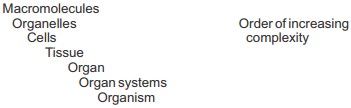
Levels of organization: The levels of organization is the hierarchy of biological
organization which begins with cell organelles to the complex organism.
Level of Organization
Examples
Macromolecules
(non living)
Macro molecules are non
living components of
living things which can
carry out simple functions
Enzymes, DNA, RNA
Organelle (non living)
Organelles are permanent
structures in cells of living
things which can carry out
complex functions like
photosynthesis, respiration
etc.
Chloroplast, mitochondria,
Endoplasmic reticulum
Cells (living)
The cell is the basic unit of
life which consists of
macromolecule and
organelles
A tissue consists of similar
cells which are
differentiated to carry out
particular function
Bone, muscle,
epidermis in plants
Organs
Organs are parts of an
organism which consist of
several types of tissues that
carry out specialized
function.
Leaf in plants,
heart in animals.
Organsystem
Group of organs that
perform related function
Circulatory system;
root system in plants
Organisms
Various organ systems
performing co ordinated
functions as a whole
Mammals, flowering plants
Germ Layers
In sexual reproduction, fertilization results to the formation of a zygote. This forms the embryo by continuous
cell division. In animals, the cells, which result from cell division or cleavage of the zygote, are differentiated into
two or three germ layers. These are: The ectoderm (outermost): the endoderm innermost and the
mesoderm (middle).
Mesoderm is present only in organisms from the flat worms to mammals. It is
found between the ectoderm and endoderm. Such condition in living organism is
described as Triploblastic in animals. Triploblastic animals are further subdivided
into ceolomates (presence of body cavity) and aceolomates (Absence of body
cavity). The platyhelminthes and nematods are examples of aceolomates while the
annelids, arthropods, mulloscs and vertebrates are examples of ceolomates.
Symmetry: Symmetry is the manner an organism or part of it may be divided into
two halves that are similar in shape, size or structure.
Types of symmetry
1
No symmetry or Asymetrical
Organism which are not
madeupoftwolike halves
e.g:Amoeba
2
Spherical symmetry
Organisms that can be
divided into equal halves
by passing a plane
in any direction fhrough a centre
3
Radial symmetry
Any line passing
through the organism
vertically through the
centre in any direction of
plane will divide it into two
halves eg: hydra and
starfish.
4
Bilateral symmetry
Animals that can be
divided into equa helves
only along a single plane
eg: all vertebrates.
General Questions
1. Among these organisms which of them is not a ceolomate.
(i) Lizard
(ii) Round worm
(iii) Rabbit
(iv) Earthworm
Write five examples of the following
2a. Radially symmetrical organisms
Teacher's attention required
b. Bilaterally symmetrical organisms
Teacher's attention required
3. Which of these organisms does not contain a mesoderm
Liver fluke
Tapeworm
Hydra
Ascaris
4. Write five types of cells that are found in the body of a named animal
Teacher's attention required
Name of the organism
The cells
5. Write out which of these animals that is radially symmetrical
(i) Centipede
(ii) Mullusc
(iii) Starfish
(iv) Crab
(v) Tapeworm
In the hierarchy of biological organization,
6. The xylem belongs to a
7. A root belongs to a
8. A brain belongs to
9. What is Triplosblastic in living things,
Teacher's attention required
10. Write two examples of organisms that do not have the two or three germ layers
11. What is an organelle
Teacher's attention required
12. Write three example of organelles
Teacher's attention required
13. Write two examples of tissues in plants
Teacher's attention required
14. Write two examples of organisms that belong to the cell level of organization.